Starting with an existing model
I worked with ChatGPT to modify the keyboard base on my desk. We started with a model I found online. I described what I wanted to change and the problems I noticed in use. ChatGPT modified the model; I 3D-printed the parts and checked the fit.
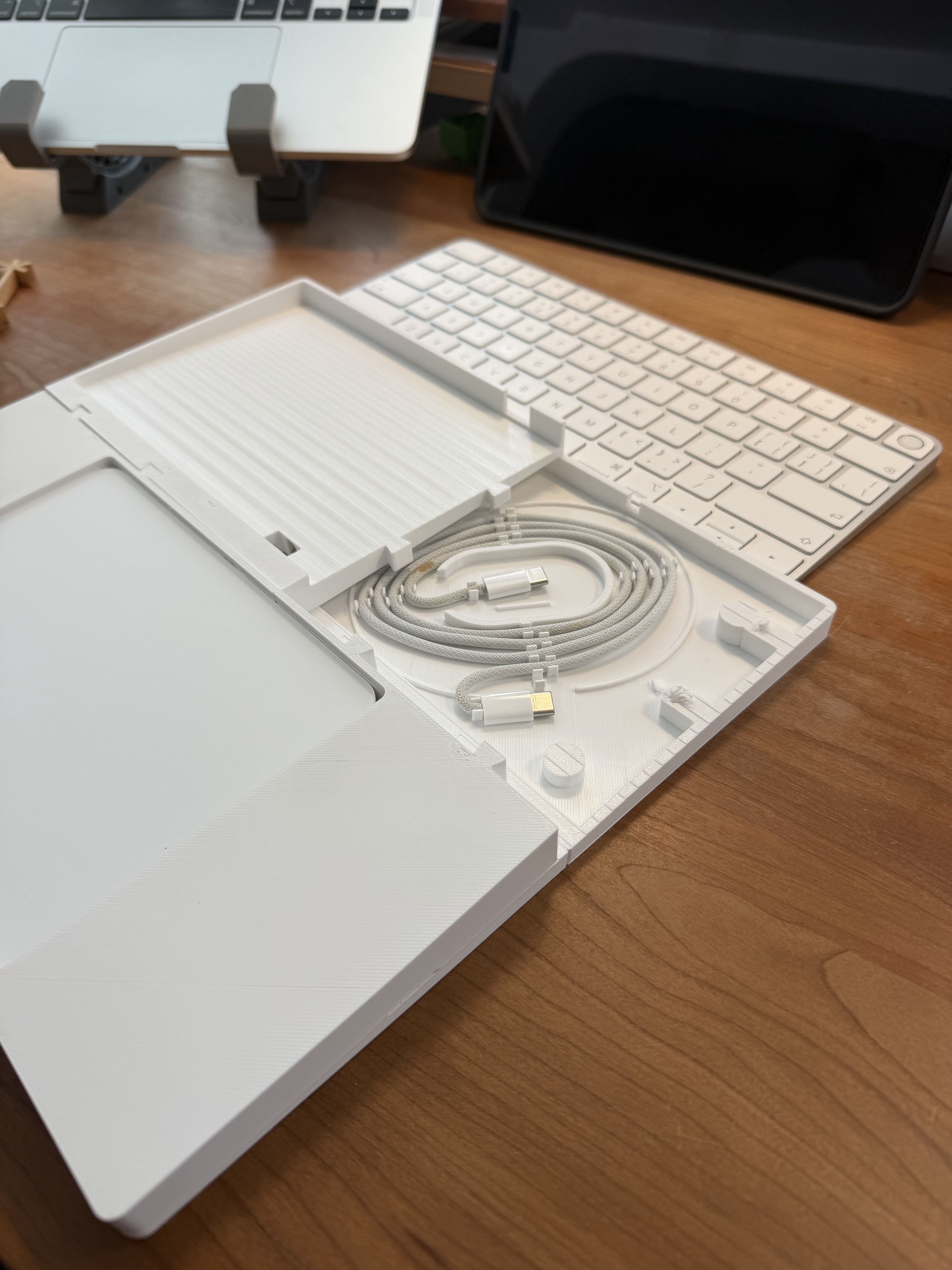
I wanted a base that brought my Magic Keyboard and Magic Trackpad together, felt more comfortable to use, and had somewhere to tuck away the cable. The first version was flat, with no tilt or storage. It already did the basic job of keeping the two devices together. Using it showed me what to change next.
The model still had to work in a print
There were many rounds of changes. At one point, a long part kept failing near the edge of the print bed. Splitting it into smaller pieces and arranging them near the centre of the bed let me move forward.
Each model change still needed printing, a fit check and actual use. When something did not work, I described the problem to ChatGPT and continued from there.
Version two is the one I use every day
The second version adds height and stores the cable underneath the keyboard. Typing feels much more comfortable to me, and I no longer have to hold my arms up. I can also use it while charging without stopping the keyboard from fitting back into the base.
These are my own impressions from using it, not ergonomic test results or a claim that it fits every setup.
Version three still needs a test print
The latest version uses six parts. There are four candidate combinations, including front-to-back and side-by-side layouts. They are still models; I have not printed version three yet.
Next comes another check of the project files, then slicing, printing and checking the fit. Whether it works well is something the test print still has to tell me.
Based on actual iteration records, with AI-assisted writing. The companion video uses AI-assisted images and an authorised synthetic version of my own voice. Version three has not been printed.
Download the actual-use combination
Published on MakerWorld China: nine objects across eight plates, with STL files and individual plate 3MFs from the corresponding stages. The model page identifies the original work and CC BY-NC-SA 4.0 license. Check and slice for your own printer and material. This package does not include the unprinted six-part third version.